
IT service request systems
Turn IT service requests into scheduled visits.
SmoothFlow builds service-request websites, urgent-help routing, missed-call text-back, and estimate flows for local IT support and managed service teams.
Urgent help path
Estimate capture
Local proof
Urgent issues need a clear next step
When WiFi, email, or office systems fail, the visitor needs a fast path to help, not a generic contact page.
Support calls need triage
A short intake path can separate urgent break-fix work from managed service or audit requests.
Estimates stall when scope is unclear
Without the right first questions, pricing and scheduling move slowly and the lead loses momentum.
What gets built
One system around how offices ask for IT help.
The page is only the visible layer. The lift comes from making urgency, service category, estimate routing, local proof, and follow-up work together.
A service-request website with paths for break-fix, managed service, audit, and office support.
Urgent help routing that keeps high-priority requests clear before the first call.
Missed-call text-back and follow-up for prospects who need help but do not finish the first request.
Pricing cues, local coverage, phone visibility, and estimate handoff that reduce friction.
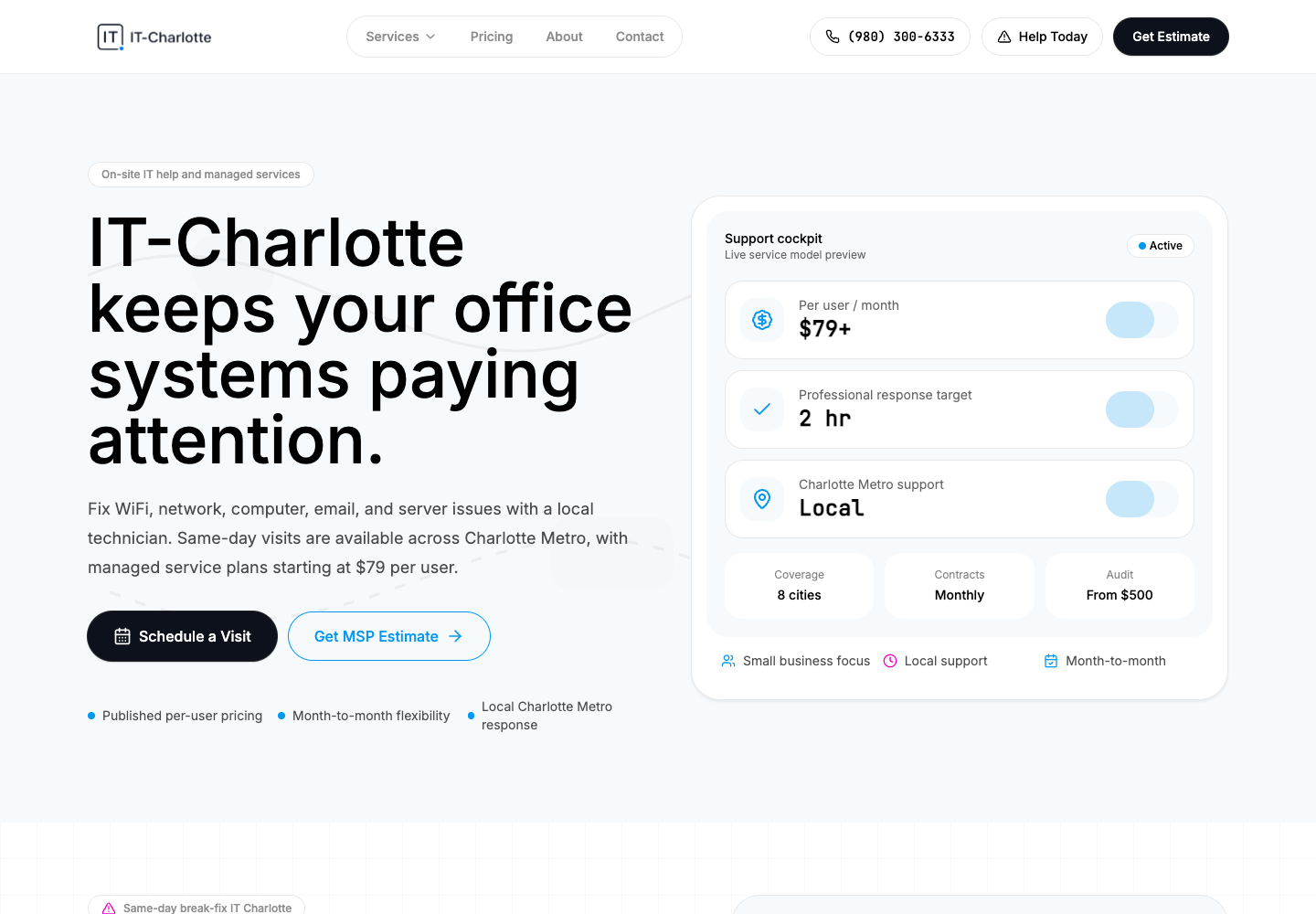
Flagship proof
IT-Charlotte shows the local service-request pattern.
The page leads with a clear local IT offer, visible phone and help actions, service paths, pricing cues, and a support preview. That is the proof pattern this IT campaign is built around.
Urgent action
Phone, help, and estimate actions are visible above the fold.
Local proof
Charlotte Metro support and response expectations appear early.
Scope cues
Pricing, coverage, contracts, and audit paths reduce uncertainty.
Text-back
Missed support calls can receive a fast response while the issue is still active.
Visit flow
Qualified requests move toward a scheduled visit, estimate, or support handoff.
Scope control
Urgency, location, device type, and service limits stay clear before the first estimate.
Service review
Find the first service-request leak.
Leave a contact and one line on where IT requests slow down. We will send back the most practical first fix.
Best fit: local IT support teams, managed service providers, break-fix technicians, office network support, and small-business tech service teams.